Showing posts with label *. Show all posts

Tuesday, February 13, 2018

PyeongChang 2018: Cheonsang Yeolcha Bunyajido


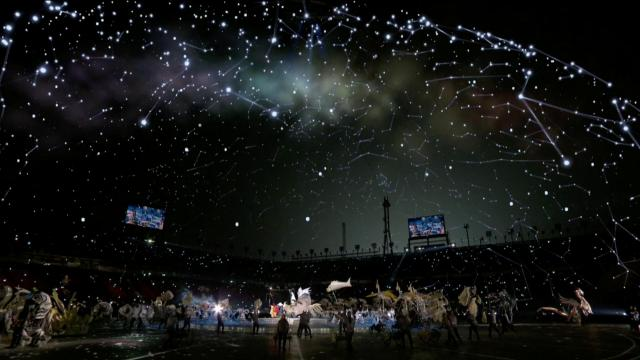
The audience present in PyeongChang didn’t get to experience the
display; the light particles were only visible on the TV screen.
While watching the Opening Ceremony of the 2018 PyeongChang Winter Olympics, I heard a short two word phrase that grabbed my attention and curiosity: “star chart.” NBC host, Mike Tirico, said “ancient South Korean star chart” and I was curious to know more. He was explaining the dome on which the stars, as mapped by Korean astronomers in the 14th century, were projected. Cheonsang Yeolcha Bunyajido (“The Chart of the Constellations and the Regions they Govern”) is the second oldest surviving astronomical map in the world, created in 1394 under the Joseon Dynasty. 264 constellations are named among the 1,467 stars whose sizes vary based on apparent 
Cheonsang Yeolcha Bunyajido
brightness in the night sky. The black marble stone, which measures 122.5 cm x 211 cm x 12 cm, is housed in the National Palace Museum of Korea in Seoul, deemed a National Treasure by the Korean government. The chart is pictured/depicted on the back of the Korean 10,000 won.


The armillary sphere is a revolving model of the celestial globe made up by rings and hoops once used by astronomers to plot the stars.         – Tony Rice, WRAL.com


I found it interesting to learn about the many scientific advancements made by this society under King Taejo, comparing it to the more common South American societies. Two other astronomy technologies were created, the Angbuilgu sun dial and the Chiljeongsan astronomical calendar ("Calculation on the Motions of the Seven Celestial Determinants"). You can read all about the Joseon Dynasty here.
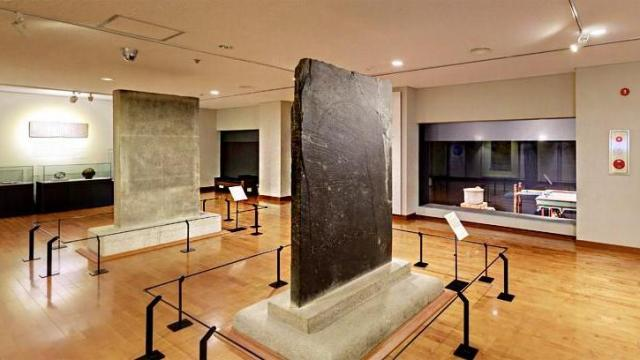



National Palace Museum and Korean currency (~ 9 U.S. dollars)

Angbuilgu and Chiljeongsan 


Works Cited
Doo, Rumy. “[PyeongChang 2018] 3 Things You Might Have Missed about the Opening 
        Ceremony.” Korea Herald, 12 Feb. 2018.
“Joseon.” KOREAN CULTURAL CENTER, Korean Culture and Information Service.
Revolvy, LLC. “Cheonsang Yeolcha Bunyajido.” Revolvy, CC-BY-SA.
Rice, Tony. “Korea's Astronomical History Featured in Opening Ceremonies.”WRAL.com, Capitol 
        Broadcasting Company, Inc., 11 Feb. 2018.

Friday, November 10, 2017

‘Women of NASA’ LEGO collection finally released


LEGO took a huge step away from your typical Star Wars, Batman, and Harry Potter sets, turning the spotlight to Women of NASA. On Wednesday, November 1st, the ‘Women of NASA’ LEGO Ideas set was officially released for purchase, consisting of four pioneering women in the space program. The idea was proposed by science editor and writer Maia Weinstock, who helped design the collection. These were “some of the most influential women who ever worked for NASA” (Nerdist).

Here's a look at what each women did, their legacies now able to be passed down to encourage and inspire young girls:  (info came from the building instructions booklet that comes with the set)

Sally Ride- was selected out of 8,000 applicants for NASA's astronaut training and became the first American woman in space in 1983. She founded Sally Ride Science and was awarded the Presidential Medal of Freedom.

Mae Jemison- was selected out of 2,000 applicants for NASA's astronaut training and became the first woman of color in space in 1992. Her work in the Peace Corps, at NASA, and in the creation of technology companies (among many other accomplishments) have led her to receive countless awards and honors such as the Women's and the International Space Hall of Fame.
(make sure to watch out for an upcoming feature on Mae Jemison)

Margaret Hamilton- an MIT computer scientist and NASA's head developer of flight software for Apollo 11, the mission whose crew were the first to walk on the Moon. She founded Hamilton Technologies and was awarded the Presidential Medal of Freedom and NASA's Exceptional Space Act Award.

Nancy Grace Roman- this activist for women in science started an astronomy club in 1936 at age eleven, was educated in the field, and became NASA's first female executive as the first ever Chief of Astronomy. As "Mother of Hubble", she is honored in various ways through NASA and she was awarded with the NASA Exceptional Scientific Achievement Medal.

A fifth woman, Katherine Johnson, whose story is the focus of the film Hidden Figures, was unfortunately not approved to be included. The two other major parts of this set are the Hubble Space Telescope (developed by Nancy Grace Roman) and the Space Shuttle Challenger (Sally Ride). Children who play with this LEGO series will see that women have gained acceptance in STEM fields and will begin to view these women as role models and examples for what they can and will accomplish.


follow the Women of NASA Lego on Twitter @LegoNASAWomen


Works Cited
Pattillo , Mia. “New Lego Set Celebrates Women in NASA.” The Brown Daily Herald, Brown 
       Daily Herald, 31 Oct. 2017, 
Walsh, Michael. “LEGO Will Honor Women of NASA in Newest Set.” Nerdist, Chris Hardwick,
       28 Feb. 2017

Wednesday, November 1, 2017

Happy Halloween

Search up "astronaut costume" on Pinterest and you'll find adorable kids smiling and posing as Neil Armstrong, and DIY projects that require high dedication to complete by October 31st. But this year, the three NASA astronauts (not the ones who rang your doorbell last night) and the other three members of the ISS crew dressed up for the spooky occasion.

They showed the world on Twitter how they celebrate in zero gravity with this photo and video: https://twitter.com/Space_Station/status/925438767162384384
My personal favorite is the Minion shirt donned by Space Station Commander, Randy Bresnik. Which costume do you like best? Let me know in the comments!

⛤⋆⛤⋆⛤

On October 26, NASA released their "Spooky Space 'Sounds'" playlist of noises such as the sci-fi Whistler Waves and Saturn's unworldly Radio Emissions, even the faint church bells of Liquid Helium. These tracks sound just like those in sci-fi films -- I wonder if the producers had access to some of these sounds in the creation of such films or if they just guessed right?! Next Halloween I won't be playing those CDs of your typical spooky Halloween sound effects, I'll be playing NASA's space sounds -- just as spooky, maybe even more so, because they tell a real story: that of the universe.
Listen to the sounds and read more from NASA here: https://www.nasa.gov/vision/universe/features/halloween_sounds.html

Monday, October 23, 2017

Orionid Meteor Shower


Orionid meteors are debris from Halley's Comet burning up in the atmosphere that appear to come out of the constellation Orion. and are best seen from midnight to dawn. Over the course of this weekend, I was only able to see one, and it was by mistake! I was sitting outside early Saturday morning, looking up, and I just turned my head and woah! So that was what I was looking for! Friday night, I had been watching for one, and wasn't sure whether or not I had seen one, because I wasn't sure what it would look like. I would see stars flicker or disappear; but it was probably just my brain messing with me. But when I saw it for real, I knew. It was a quick flash, light streaked across the sky. But it was near Cassiopeia...to the north...Orion was to the south. I knew there'd only be approximately 18 meteors an hour, so I knew my chances of seeing a lot were slim, but I found it odd that the only one I did see came from the "wrong" part of the sky.
I didn't take any measurements because I just wanted to watch for another shooting star (negative), but I did get to see new stars and constellations like Sirius and Taurus that I hadn't seen before.

Of course I wish I'd seen more of the Orionids (next year!!), but it was a beautiful sky and a peaceful and memorable experience.


read my previous post about the Draconoid Meteor Shower here: http://northstargazer.blogspot.com/2017/10/draconid-meteor-shower.html

Wednesday, October 11, 2017

Draconid Meteor Shower

This past weekend marked the annual Draconid Meteor Shower seen in the higher latitudes in the Northern Hemisphere. The best time to look is right at nightfall near Draco the Dragon (constellation between the two Dippers); and no telescope is needed, as it could be seen with the naked eye. The 'shooting stars' you may have seen across the sky are dust and rocks from the comet 21P ("Giacobini-Zinner") that burn up in the atmosphere as the Earth passes through the debris.

"During the 2011 Draconid shower, more than 600 meteors per hour were visible in the sky" (Science Alert), but "although the Draconids have been responsible for some of the most spectacular meteor showers in recorded history, most recently [...] star gazers consider these to be one of the least interesting meteor showers" (Time and Date).


While I was in a location without much light pollution over the weekend, there was still a presence of ambient light around me and also coming from the bright moon. Additionally, it has been a fairly rainy week, so the sky wasn't clear enough for me to be able to observe the Draconids. But luckily, there will be a second opportunity to see a meteor shower - the Orionids - on October 21st. I was disappointed that the cloudy weather ruined my chance to see (as Time and Date called it) these "majestic celestial fireworks" ... but I look forward to the upcoming Orionid shower.


Works Cited
"Draconid Meteor Shower." Timeanddate.com. N.p., n.d. Web. 7 Oct. 2017.

MacDonald, Fiona. "Don't Miss The Draconid Meteor Shower Peaking This Weekend."ScienceAlert. N.p., 7 Oct. 2017. Web. 7 Oct. 2017.

Friday, September 22, 2017

Is the End of the World Really Just Hours Away??

When I originally heard about this supposed apocalypse predicted to be tomorrow, this is what I heard: there's a planet behind the Sun that's getting closer to Earth but we can't see it. On September 23, 2017, it will crash into Earth and kill us all. 
       ... like the dinosaurs, I'd thought.

"Planet X's passage could be the greatest catastrophic infliction of loss of life upon mankind since Noah's Ark."  ~Planet X - The 2017 Arrival

Planet X, also known as Nibiru was first mentioned in 1976 in Zecharia Sitchin's book The 12th Planet. David Meade looked to the Bible (and Pyramids of Giza) for clues leading to his prediction that the end of the world is near. Nibiru will pass the Earth (as it supposedly does every 3,600 years) and cause a myriad of disasters, including: flooding, earthquakes, volcanic eruptions, climate change, and pole shifts. He has, however, since changed his mind, saying, "The world is not ending, but the world as we know it is ending." While Meade first pointed to Luke 21:25-26 and Revelation 12:1 which reference natural occurrences like the August 21st Great American Solar Eclipse and the recent tragic hurricanes Harvey and Irma, he now claims that disastrous events will be happening over the next few weeks, casuing October to bring about a world much different than the world we know and once knew.

NASA says that this, as with all other past conspiracies, is a hoax: "If Nibiru or Planet X were real and headed for an encounter with the Earth...astronomers would have been tracking it for at least the last decade and it would be visible by now to the naked eye. Obviously it does not exist." It just does not make logical sense that Planet X could be behind the Sun; unlike the moon, we see all sides of the Sun as we revolve around it over the span of 365 days. Scientists say it would take Planet X ten years to enter the inner solar system, so we would have seen the planet six months ago (and 18 months ago and so on) when we were facing the other side of the Sun. Meade's argument was that Nibiru is a "very dim object." And in the event that we did not detect Planet X any other way, it would not go unnoticed when the orbits of other planets were disrupted. "New worlds don't appear instantaneously on any given weekend," as reported by Forbes this morning.

9/22/17 10:45 pm 
Well, it's September 23rd somewhere in the world and I'm still here. I'll check back when it's September 23rd for me and see whether or not the world has ended. 

9/23/17 9:20 am
As far as I can tell, I'm still alive  ;)

9/23/17 3:50 pm
It's been a beautiful day - the opposite of a disaster. No signs of the seven years of tribulation. 

9/24/17 8:30 am
Just like all the other past predictions of the end of the world, Meade's is just another one to add to the list of inaccuracies. We don't know when the world will end. We may never see it, or it may be tomorrow. All we can do is live life to the fullest 🎔


Works Cited
Devlin, Amanda. “Is the End of the World on September 23 and What Is David Meade’s
       Theory about the Great American Solar e.” The Sun, 22 Sept. 2017, www.thesun.co.
       uk/tech/4474635/end-of-the-world-september-23-david-meades-theory-planet-x-
       great-american-solar-eclipse/amp/.

Gore, Leada. “Nibiru, Planet X and Biblical Prophecy: Will the World End Sept.

       23?” AL.com, 22 Sept. 2017, www.al.com/news/index.ssf/2017/09/nibiru_planet
       _x_and_biblical_p.html.

Mack, Eric. “The End Of The World Is Coming, But Not From Nibiru On September

       23.” Forbes, Forbes Magazine, 22 Sept. 2017, www.forbes.com/sites/ericmack/2017
       /09/22/nibiruplanet-x-earth-2017-youtube-nasa/.

May, Ashley. “Man Who Said the World Is Ending Saturday Changed His Mind. It Isn't

       Actually Ending.” USA Today, 22 Sept. 2017, amp.usatoday.com/story/692907001/.

“Planet X & NASA.” Planet X The 2017 Arrival, writers-web-services.com/white-paper-on-

       nibiru-planet-x/.

Walker, Robert. “Why An Extra Planet Can't Be Hidden Behind The Sun Or Above The

       South Pole.” Science 2.0, 23 July 2016, www.science20.com/robert_inventor/why
       _an_extra_planet_cant_be_hidden_behind_the_sun_or_above_the_south_pole-
       177116.

Monday, August 21, 2017

It's Eclipse Day!!

Hi everyone! Today was an exciting day...when the moon crossed in front of the sun, in perfect alignment with the Earth. Watching the news, I was amazed at the size of the crowds, a truly national (and international - one reporter said 20 countries were represented) gathering for everyone to experience, what could be a once in a lifetime event. I saw a smiling bride and groom standing among a crowd, looking up toward the darkened afternoon sky; and it appears many couples said 'I do' today during the total solar eclipse. I watched as people waited anxiously, followed by cheers, in Saluki Stadium, Carbondale, Illinois - where tickets cost up to ten thousand dollars. And after they saw its totality -the longest duration: 2 minutes and 41 seconds- they were able to see Venus in the sky (might I remind you this was in early afternoon!). What an amazing sight it must have been!

As for how I experienced the eclipse, well...the glasses were all sold out, so I consulted the internet for how to experience it without looking at the sun! The Washington Post came through, providing me with easy directions for a pinhole projector. I used a Thin Mints box because I of course wanted to make the box be a special one and what better way to celebrate an eclipse than with cookies! Making it was so simple - white paper goes on the inside for the screen, cut two squares, cover one with foil, poke a hole through the foil, that's pretty much it. So here's my box and here's the best picture I could get of what I could see. Looking at the image of the sun is so incredibly misleading because its the middle of the afternoon and you see what looks like a crescent moon and it's just amazing and so fun to look at! Unfortunately my picture below does not do it justice for what I could really see (and of course what the people in the path of totality could see!). In my area, the peak time for the solar eclipse was 2:41 pm EDT, I watched from 2 to 3, and when I looked through my projector again at 4, the sun's image was a complete circle again!


and these three...well...they're just really cool to look at  :)


in these, you can see the sun and moon overlapping
Mercury is on the left, Mars is on the right, and Venus is at the bottom of the last picture
these were taken, respectively at: 12:30, 2:05, 2:15 and 3:15

Don't worry, if you weren't in the path of the total solar eclipse this year in 2017, the next one will be April 8, 2024. Check the map below from NationalEclipse.com to find out if you'll get the chance to see it! I'll be able to see it - will you? (Or will you be lucky enough to be right in that spot where the two paths collide and you get to see it twice?)

Also, check out this map from GreatAmericanEclipse.com to see all the future solar eclipses in the next hundred years

Now I want to hear about what you did and what you saw today! Let me know in the comments down below! I hope everyone had the chance to enjoy such a great phenomena on this exciting day!

💖,
The North Star Gazer 🌟