An hour earlier in the night two days after last viewing Leo and the Moon, the constellation was now positioned more above the Moon than next to it. This waxing gibbous was 150° southeast and 40° above the horizon.
Showing posts with label space exploration. Show all posts
Monday, July 30, 2018
Waxing Gibbous Moon
An hour earlier in the night two days after last viewing Leo and the Moon, the constellation was now positioned more above the Moon than next to it. This waxing gibbous was 150° southeast and 40° above the horizon.
Saturday, June 30, 2018
Leo and the Sickle Later in the Year
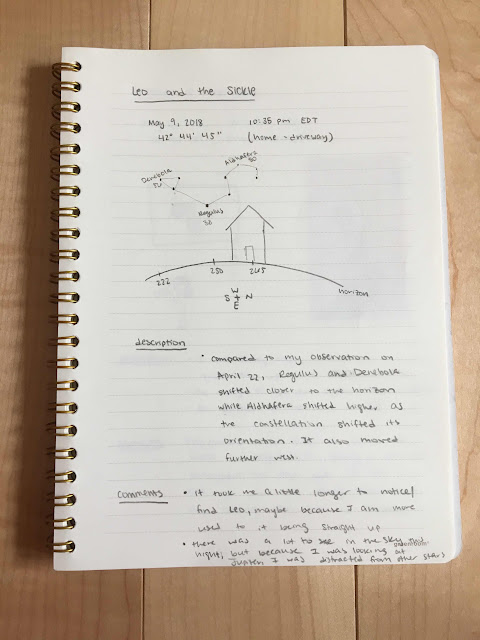
The night I recorded this was the night I saw Jupiter with my telescope, so I was focused much more on that and only on Leo briefly. At the same time two weeks later, the Sickle had angled slightly more upwards and the constellation moved west.
Compared to April 22 when Regulus was at a 235° azimuth and a 50° altitude, it was now at a 250° azimuth and 38° altitude.
Leo and the Sickle
Leo is the constellation which is recognizable by its "backward question mark," the Sickle. (I apologize I accidentally labeled the lion's tail as the Sickle in my drawing). The brightest star in the constellation is Regulus, who, on this night was situated 235° west with a 50° altitude.
As mentioned in my previous observation, I had looked at Leo once before, not looking for it specifically, but was happy that I was able to recognize it. That night, along with this, will be the memories I keep of my first experiences with the constellation of Leo the Lion, which truly is spectacular.
First Quarter Moon
This first quarter moon shone in the western sky below the constellation Leo at an altitude of 37°. I had seen Leo once or twice before, but this time was the first time I really started to learn it (see my next post about Leo). I also found it interesting to see where Castor and Pollux we’re positioned, compared to when I first saw them in the fall.
Sunday, April 8, 2018
Full Moon
I'm back to my observations for class, starting with the Full Moon, which, on March 31st was also called the Blue Moon (second full moon in a single month, space.com) or the Full Sap Moon (full moon at the time of year when sap starts to flow in maple trees, almanac.com). I really enjoyed the color of this moon, which I described as similar to that of a yellow-orange light bulb. I caught it when it was low in the eastern sky and it was very neat to see it rise -fairly quickly- up above the house across the street. The rest of the sky was cloudy; luckily, it was just this one spot where the moon was that was clear. :)
Sunday, December 31, 2017
Altitude of the Sun (pt. 2)
Quoted from my Part One post, “When measuring the altitude of the Sun, it is important not to look directly at the sun” yet in this observation, that’s what I did. However the Sun was so low in the sky (5°) and I only saw a few rays through the trees (through the small hole of the quadrant) that even though my eyes were exposed to UV Rays, I did not consider it “looking into the Sun.”
At 3:50 pm EST on December 14, 2017, the Sun was 5° above the horizon
Friday, December 29, 2017
Polaris, Cassiopeia, and the Big Dipper Later in the Night
Two and a half hours later, Cassiopeia had slightly shifted position [*vertical, not horizontal] and I didn’t think the Big Dipper changed very much. So there wasn’t much to report for changes. Once again, the southeastern sky was an astounding sight and I’m so glad that this night gave me many observation opportunities. ✪ The sky was absolutely perfect. ♥
Related Observations:
Polaris, Cassiopeia, and the Big Dipper http://northstargazer.blogspot.com/2017/10/polaris-cassiopeia-and-big-dipper.html?m=1
Polaris, Cassiopeia, and the Big Dipper Later in the Year http://northstargazer.blogspot.com/2017/12/polaris-cassiopeia-and-big-dipper-later.html?m=1
Polaris, Cassiopeia, and the Big Dipper Later in the Year
When I went out this night, there was so much to see and being out there left me with such a happy feeling.
For this task I had to view Polaris, Cassiopeia, and the Big Dipper and compare what I saw to when I observed them earlier in the year (10/1). I noticed a shift in the orientation of the Big Dipper and that Cassiopeia had moved to the opposite side of Polaris.
It wasn’t necessary that I included these in my drawing, but I saw Castor and Pollux, Capella, and Orion, the latter two of which were very bright.
The next task was to go out a few hours later and look at the same things again, so let’s check out what I saw later in the night!
Related Observations:
Polaris, Cassiopeia, and the Big Dipper http://northstargazer.blogspot.com/2017/10/polaris-cassiopeia-and-big-dipper.html?m=1
Polaris, Cassiopeia, and the Big Dipper Later in the Night http://northstargazer.blogspot.com/2017/12/polaris-cassiopeia-and-big-dipper-later_29.html?m=1
Tuesday, December 19, 2017
Super Full Moon
I was expecting a little more from this Super Full Moon, but it honestly didn't seem too much larger than normal. The coloration of the sky was very cool: a glowing blue-green sky closest to the moon and getting darker and deeper blue going outward. According to timeanddate.com, a Supermoon is "a Full or New Moon that occurs when the center of the Moon is less than 360,000 kilometers (ca. 223,694 miles) from the center of Earth." and a Super New Moon is 12-14% larger than normal, which explains why my expectation of "super" was not completely met.
Yesterday (12/18) was actually the Micro New Moon. It was cloudy, but I could see a little bit of a pink color in the sky.
Monday, December 18, 2017
International Space Station ☄
I had a schedule of when the ISS would be in the sky each night, and for two weeks, I'd been watching for it, but it was always cloudy. The first day I looked, it was a clear night and I was looking in the right spot, but for some reason, I just didn't see it. Now, I can't believe that I didn't see it that night because when I finally saw it for this observation, it was so big compared to the stars, shining brightly and moving fairly quickly in an arc across the sky. I remember stepping outside and looking up, spotting the ISS immediately. A smile stretched across my face - I was happy, excited, and thinking about the astronauts and scientists up there. Once the space station started to leave my view, I remember taking off one shoe and hopping one-footed through my house to the front door so I wouldn't let the snow inside. I watched the ISS pass through Cassiopeia (my favorite constellation), travel east, and then set behind the trees. It was suddenly over, but those two minutes of awe and excitement were one hundred percent worth it.
Tuesday, December 12, 2017
Third Quarter Moon
Sunday, November 12, 2017
Image of the Sun (pt. 2)
This was my second of three times looking at the image of the Sun as it appears on a folder through the quadrant. Here's a quick look at the differences between my two observations:
Part 1 Part 2
October 2 November 8
4:20 pm EDT 3:45 pm EST
23° altitude 9° altitude
The shape on both days was approximately the same, but again, not spherical like you would imagine the Sun's reflection being. The change in altitude would also need to take into account the fact that we changed from Daylight Savings to Standard Time, meaning that when I looked that the Sun's image for the second time, it was equivalent to 4:45 when I had done part 1, so the Sun would have been lower in the sky anyways; but there is also the factor that the Sun is getting lower in the sky as we move toward winter. So there are two factors that made the altitudes so different from one another.
read my Image of the Sun (pt. 1) post here: https://northstargazer.blogspot.com/2017/10/image-of-sun-pt-1.html
Friday, November 3, 2017
Waxing Gibbous
I stepped outside on Halloween to see just what you'd expect on this holiday: a spooky Halloween Moon. Unfortunately, it wasn't a Full Moon, it was a Waxing Gibbous. But the way the clouds were situated around it, with bright light shining through only made me think of ghouls and goblins galore.
I did some quick measurements: it was 30° above the horizon at 170° S. I noticed that it seemed a bit smaller than normal, and I wondered why it had finally come back up from beneath the horizon as it had been in previous nights.
Monday, October 23, 2017
Orionid Meteor Shower
Orionid meteors are debris from Halley's Comet burning up in the atmosphere that appear to come out of the constellation Orion. and are best seen from midnight to dawn. Over the course of this weekend, I was only able to see one, and it was by mistake! I was sitting outside early Saturday morning, looking up, and I just turned my head and woah! So that was what I was looking for! Friday night, I had been watching for one, and wasn't sure whether or not I had seen one, because I wasn't sure what it would look like. I would see stars flicker or disappear; but it was probably just my brain messing with me. But when I saw it for real, I knew. It was a quick flash, light streaked across the sky. But it was near Cassiopeia...to the north...Orion was to the south. I knew there'd only be approximately 18 meteors an hour, so I knew my chances of seeing a lot were slim, but I found it odd that the only one I did see came from the "wrong" part of the sky.
I didn't take any measurements because I just wanted to watch for another shooting star (negative), but I did get to see new stars and constellations like Sirius and Taurus that I hadn't seen before.
Of course I wish I'd seen more of the Orionids (next year!!), but it was a beautiful sky and a peaceful and memorable experience.
read my previous post about the Draconoid Meteor Shower here: http://northstargazer.blogspot.com/2017/10/draconid-meteor-shower.html
Waning Crescent
I was unable to do the Third Quarter phase, because it's been so cloudy lately. But luckily, I caught the Waning Crescent in the morning. When I had looked at the sky earlier that same morning, the stars were so clear; but now, it had gotten lighter and cloudier so I couldn't see any surrounding stars. I also found it a little odd that the crescent was at the bottom rather than the side of the moon, but maybe that was because of the time I did my observation.
Monday, October 16, 2017
Cygnus and the Summer Triangle
This night, I met my class outside around 10 pm. The sky was so dark and clear, the stars so bright. There were not many trees around so I was able to see a much larger portion of the sky than I can at home. This allowed me to see and be able to recognize a few new constellations: Cepheus, the Northern Cross and Summer Triangle. After I got back home, I looked up, and there they were - I saw them on my own, without the aid of a teacher, map, or app! And there they were again the next night! I need to research why the moon was below the horizon - must be the positioning of the earth this time of year, but I had never thought that was something that happens...
Wednesday, October 11, 2017
Waning Gibbous
Three days later, the moon had moved a little bit southward and higher in the sky since Full. Its azimuth changed from 105° to 120° and altitude from 12° to 20°. I'm not sure if this had something to do with the fact that the sky wasn't super clear or if it's normal, but I found it odd that it was more the top corner than a side sliver that made up the Waning Gibbous Moon.
Full Moon
This is my first entry for the phases of the moon. It was a cloudy night, but I was still able to see how bright the full moon was. It was in the southeastern part of the sky (azimuth = 105°) and 12° above the horizon. I'll be looking at the moon every few days to watch its complete cycle as it rotates around the Earth.
Monday, October 9, 2017
azimuth & altitude project
This was just a little project we had in Space Ex to practice the skills in measuring azimuth and altitude of celestial objects.
azimuth = the angle of an object along the horizon from due north, measured with a compass
altitude = the angle of an object above the horizon, measured with quadrant/astrolabeFor the objects that I did repeat, I think it's cool to see how they changed position in the night sky. The morning I saw Orion was amazing because it was the first time I'd seen it in a while, and (of course) I was excited about Cassiopeia as well. I've also come to be able to recognize Altair, Polaris, Vega, and Dubhe.
I've learned so much from these observations and it just makes me feel so happy and good inside!!!
keep learning
never stop star gazing
never stop dreaming
🌟
Wednesday, October 4, 2017
Image of the Sun (pt. 1)
For a few spaced-out days (no pun intended), I'll be looking at the image of the Sun, looking for any changes. I'm not sure what, if any, changes I'll see - maybe size, shape, altitude ... we'll have to see! This one was super simple - just position the folder/paper/hand and the quadrant in the right spot so that the image of the sun is reflected onto the screen. I've only done it a few times but it's so simple and quick - anyone can do it! In the comments section of my report, I noted that the image was not spherical - I really want to look more into this and find out why.
Subscribe to:
Posts (Atom)


