Saturday, September 30, 2017

observation notebook

The major project for my Space Exploration class is to have a series of at least 25 observations of the sky based on certain tasks and criteria. I decided to take you along with me to see everything that I am doing, from last week until December 15th, when the notebook is due.

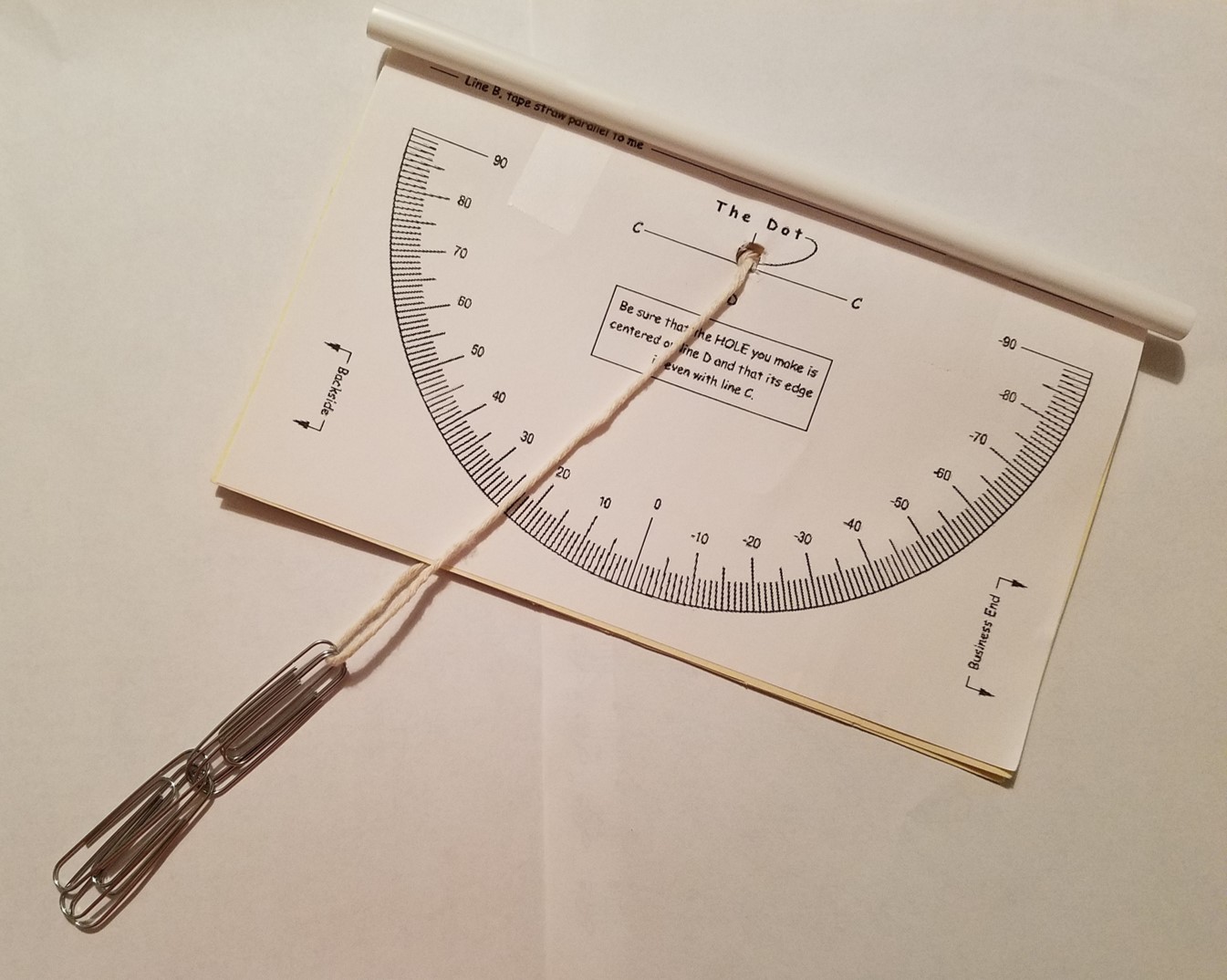
My first step was heading to Target to get a notebook. I chose this one because it was a little space-y looking. A friend of mine can do really good cursive, so I am going to have her write "observation notebook" all fancily on the front cover for me. In class, we made quadrants from a template, string, paper clips, and a straw. Quadrants are used to measure the altitude of an object above the horizon. My other supplies for these activities are: a compass, a star chart, the packet of directions, and my SkyView app. Last week I printed a calendar and went through the packet, writing down which day I was going to look at/for each thing.

Check out my pictures below and follow all the observations that I'll post as I do them.

 
these are all the observations I hope to make, but depending on whether or not there are clouds one night or if I have something else going on, I may not get them all

look through the straw at the object being observed and look for the angle as marked by the string...this is the object's altitude

Friday, September 22, 2017

Is the End of the World Really Just Hours Away??

When I originally heard about this supposed apocalypse predicted to be tomorrow, this is what I heard: there's a planet behind the Sun that's getting closer to Earth but we can't see it. On September 23, 2017, it will crash into Earth and kill us all. 
       ... like the dinosaurs, I'd thought.

"Planet X's passage could be the greatest catastrophic infliction of loss of life upon mankind since Noah's Ark."  ~Planet X - The 2017 Arrival

Planet X, also known as Nibiru was first mentioned in 1976 in Zecharia Sitchin's book The 12th Planet. David Meade looked to the Bible (and Pyramids of Giza) for clues leading to his prediction that the end of the world is near. Nibiru will pass the Earth (as it supposedly does every 3,600 years) and cause a myriad of disasters, including: flooding, earthquakes, volcanic eruptions, climate change, and pole shifts. He has, however, since changed his mind, saying, "The world is not ending, but the world as we know it is ending." While Meade first pointed to Luke 21:25-26 and Revelation 12:1 which reference natural occurrences like the August 21st Great American Solar Eclipse and the recent tragic hurricanes Harvey and Irma, he now claims that disastrous events will be happening over the next few weeks, casuing October to bring about a world much different than the world we know and once knew.

NASA says that this, as with all other past conspiracies, is a hoax: "If Nibiru or Planet X were real and headed for an encounter with the Earth...astronomers would have been tracking it for at least the last decade and it would be visible by now to the naked eye. Obviously it does not exist." It just does not make logical sense that Planet X could be behind the Sun; unlike the moon, we see all sides of the Sun as we revolve around it over the span of 365 days. Scientists say it would take Planet X ten years to enter the inner solar system, so we would have seen the planet six months ago (and 18 months ago and so on) when we were facing the other side of the Sun. Meade's argument was that Nibiru is a "very dim object." And in the event that we did not detect Planet X any other way, it would not go unnoticed when the orbits of other planets were disrupted. "New worlds don't appear instantaneously on any given weekend," as reported by Forbes this morning.

9/22/17 10:45 pm 
Well, it's September 23rd somewhere in the world and I'm still here. I'll check back when it's September 23rd for me and see whether or not the world has ended. 

9/23/17 9:20 am
As far as I can tell, I'm still alive  ;)

9/23/17 3:50 pm
It's been a beautiful day - the opposite of a disaster. No signs of the seven years of tribulation. 

9/24/17 8:30 am
Just like all the other past predictions of the end of the world, Meade's is just another one to add to the list of inaccuracies. We don't know when the world will end. We may never see it, or it may be tomorrow. All we can do is live life to the fullest 🎔


Works Cited
Devlin, Amanda. “Is the End of the World on September 23 and What Is David Meade’s
       Theory about the Great American Solar e.” The Sun, 22 Sept. 2017, www.thesun.co.
       uk/tech/4474635/end-of-the-world-september-23-david-meades-theory-planet-x-
       great-american-solar-eclipse/amp/.

Gore, Leada. “Nibiru, Planet X and Biblical Prophecy: Will the World End Sept.

       23?” AL.com, 22 Sept. 2017, www.al.com/news/index.ssf/2017/09/nibiru_planet
       _x_and_biblical_p.html.

Mack, Eric. “The End Of The World Is Coming, But Not From Nibiru On September

       23.” Forbes, Forbes Magazine, 22 Sept. 2017, www.forbes.com/sites/ericmack/2017
       /09/22/nibiruplanet-x-earth-2017-youtube-nasa/.

May, Ashley. “Man Who Said the World Is Ending Saturday Changed His Mind. It Isn't

       Actually Ending.” USA Today, 22 Sept. 2017, amp.usatoday.com/story/692907001/.

“Planet X & NASA.” Planet X The 2017 Arrival, writers-web-services.com/white-paper-on-

       nibiru-planet-x/.

Walker, Robert. “Why An Extra Planet Can't Be Hidden Behind The Sun Or Above The

       South Pole.” Science 2.0, 23 July 2016, www.science20.com/robert_inventor/why
       _an_extra_planet_cant_be_hidden_behind_the_sun_or_above_the_south_pole-
       177116.

Saturday, September 16, 2017

This Day In Space History: September 16

1848

In 1848, two discoveries of Saturn's largest nonspherical moon, Hyperion, were made independent of each other. Those credited with the discovery are both William Lassell (1799-1880) and William Cranch Bond (1789-1859) and his son George Phillips Bond (1825-1868). Learn all about Hyperion here: https://solarsystem.nasa.gov/planets/hyperion

1945

One of the V-2 Blossom rockets exploded after its launch, with cynomolgus monkey Albert III aboard. Albert survived in space but died on impact. Learn about all the Alberts here: http://www.popsci.com/blog-network/vintage-space/alberts-spaceflights-unsung-heroes#page-4

1975

The maiden flight of the Russian aircraft Mikoyan MiG-31 Foxhound. This model is able to intercept, detect, and destroy cruise missiles and carry strategic bombs.  Between 1981 and 1994, 519 crafts were produced and continue to be used. 

1996

Space shuttle STS-79 (Atlantis 17) is launched for its docking on the Mir space station. The mission was delayed three times, first for a change in its assembly and twice in order to avoid Hurricane Bertha and then Hurricane Fran. The mission lasted ten days. Shannon Lucid was replaced by John Blaha as the crewmember for NASA on Mir. One of the power units failed after thirteen minutes, but it was decided that the mission would continue. 


For a complete list of today’s Space History, see  http://www.astronautix.com/s/september16.html

Monday, September 11, 2017

This Day In Space History: September 11

𝓹𝓻𝓪𝔂𝓮𝓻𝓼 𝓽𝓸 𝓪𝓵𝓵 𝓿𝓲𝓬𝓽𝓲𝓶𝓼, 𝓯𝓪𝓶𝓲𝓵𝓲𝓮𝓼, 𝓪𝓷𝓭 𝓯𝓲𝓻𝓼𝓽 𝓻𝓮𝓼𝓹𝓸𝓷𝓭𝓮𝓻𝓼 𝓸𝓷 𝓽𝓱𝓲𝓼 𝓼𝓲𝔁𝓽𝓮𝓮𝓮𝓷𝓽𝓱 𝓪𝓷𝓷𝓲𝓿𝓮𝓻𝓼𝓪𝓻𝔂 𝓸𝓯 𝓼𝓮𝓹𝓽𝓮𝓶𝓫𝓮𝓻 𝓮𝓵𝓮𝓿𝓮𝓷𝓽𝓱 ✞💖

1877

Sir James Jeans (1877-1946) was born in London. In his lifetime, this mathematician, physicist, and astronomer would teach at Cambridge and Princeton. Jeans would also study radiation and the stars, including their energy and different types of stars and star systems. He disproved Laplace's nebular hypothesis and supported Thomas C. Chamberlin's catastrophic theory; saying that the planets were formed by the condensing of stellar debris, rather than from a 'single gaseous cloud'. For those interested, Jeans' books are listed here.

1941

https://newspapers.ushmm.org/events/charles-lindbergh-makes-un-american-speech
Shortly before the Japanese attack on Pearl Harbor in a speech in Des Moines, Iowa, great American aviator and, at this time, an isolationist, Charles Lindbergh names three groups he believes are pushing the U.S. to enter the war: "the British, the Jewish, and the Roosevelt Administration."

1967

Launched just three days before, the Surveyor 5 spacecraft lands on the moon, conducts a variety of experiments and sends images back to Earth. In this first lunar day, Surveyor had sent back 18,000 pictures, and 83 hours worth of data on the composition of the moon's soil. Learn more about the mission here: https://nssdc.gsfc.nasa.gov/nmc/spacecraftDisplay.do?id=1967-084A

1985

The International Cometary Explorer (ICE) was a repurposed mission - originally the Sun-Earth Explorer-3. When ICE flew by the comet Giacobini-Zinner in 1985, it became the first spacecraft to pass a comet. Learn more about the Giacobini-Zinner comet here:
https://solarsystem.nasa.gov/planets/21pgiacobinizinner/indepth


For a complete list of today’s Space History, see  http://www.astronautix.com/s/september11.html

Sunday, September 10, 2017

This Day In Space History: September 10

1857

American astronomer James Keeler is born in Illinois. In his lifetime, Keeler would study at Johns Hopkins, write in science journals, and manage different observatories, where he imaged 120,000 galaxies with a Crossley 36-inch telescope, proving that the most common type of galaxy is the spiral. Among his other achievements include his verification that the rings of Saturn are composed of tiny particles rather than being solid, and his measurement of the rate at which the Orion Nebula expands in the Milky Way Galaxy.

1984

After its first launch on August 30th, the space shuttle Discovery returns to the Kennedy Space Center.


For a complete list of today’s Space History, see  http://www.astronautix.com/s/september10.html

Monday, September 4, 2017

This Day In Space History: September 4

1682

https://www.britannica.com/biography/Edmond-Halley
https://www.britannica.com/topic/Halleys-Comet
What came to be known as Halley's Comet was observed by English astronomer Edmund Halley. Among the many things he studied were comets. Noticing a similarity in the chaarcteristics of comets seen in 1531, 1607, and 1682, Halley determined it was the same comet returning -- Halley's Comet. In his measurements and studies, he accurately predicted its 1758 return. Halley's Comet, which came closest to Earth on April 10, 1986 at 0.417 AU, was the first comet to be imaged by spacecraft. It will next be seen from Earth in 2061.

1933

http://www.jitterbuzz.com/MAN_1933_05.html
The Wedell-Williams Model 44 airplane sets a record speed of 300 mph at the International Air Race near Chicago, piloted by Jimmie Wedell.

2011

NASA's Gravity Recovery and Interior Laboratory (GRAIL) mission is launched, sending two twin probes -Ebb and Flow- to orbit the Moon. According to NASA, "The [mission's] goal was to reveal differences in density of the Moon's crust and mantle and will help answer fundamental questions about the Moon's internal structure, thermal evolution and history of collisions with asteroids." 


For a complete list of today’s Space History, see  http://www.astronautix.com/s/september04.html

Sunday, September 3, 2017

This Day In Space History: September 3

1968

The Apollo 8 readiness date is announced to have been changed to Dec. 13,1968, according to Program Director Samuel C. Phillips.

1976

Launched Sept. 9, 1975, Viking 2 made a soft landing on the surface of Mars in the crater Utopia Planitia, returning images of the soil (no evidence of life) and frost - contributing to the mission's provision of information about Mars' climate and its mapping of Mars' surface: "The Viking program provided the first up-close look at Mars" (space.com). 
This article gives much additional information about Viking 2 and includes links to the incredible images from the program: https://www.wired.com/2010/09/0903viking2-mars/

1985

STS 51-I (Discovery 6) which was launched Aug. 27 (on its third attempt) returns to Earth at the Edwards Air Force Base after 7 days, 2 hours, 17 minutes, and 42 seconds.

1995

Members of the Mir-20 crew were launched on Soyuz TM-22 from the Baikonur Cosmodrome to the Mir space station where they would dock two days later and conduct experiments alongside with other crews.

2006

https://amp.space.com/21197-moon-crash-meteor-impact-explosion.html
Launched on Sept. 27, 2003, the ESA's high tech space probe, the first European craft to orbit the moon, Small Missions for Advanced Research and Technology (START 1) makes its controlled crash into the moon at 1:42 am EDT -just seconds within its predicted time.


For a complete list of today’s Space History, see  http://www.astronautix.com/s/september03.html

Thursday, August 31, 2017

Dream Big Galaxy Bracelet


Inspired by Oh The Lovely Things' galaxy necklace, I sought to make my own similar creation, which was super easy and quick to make. So off I went to Hobby Lobby for the supplies.
    Here are the materials I used to make my galaxy bracelet:
    • bracelet cord • "dream big" charm • mini star charms • jump rings • a sponge • jewelry pliers • different colored nail polish •
    note: you only really need a few colors, but I had so many  appropriate colors at home that I added a good majority of the ones pictured here


    I started with a dark base coat, which I applied with the brush and let sit to dry. Then I just went a little crazy sponging on the colors (I literally have no control!!), continuously adding a dab of pink here and a dab of green there, oh wait! a tad bit more of pink and so on and so forth. Once it had dried and I was happy with how the colors looked blended together, I put some clear polish with glitter as my top coat, giving it that starry feel I was going for.

    here's what the charm ended up looking like - I used different light settings so you could see the depth of all the colors (and the glitter!)

    The assembly was also very simple: First, I opened up two jump rings with the pliers, fitting the ends of the charm into the rings. Next, I added one star charm to the jump ring so that it would slightly overlap the main charm. Lastly, I closed the jump rings around the clasps in the cord to put the whole piece together.


    This was so simple to make, but it looks great and provides a nice message - DREAM BIG - to those like me who like to gaze at the sky, always dreaming, always wondering.


    Once again, a special thanks to Oh the Lovely Things for the inspiration - originally on a beautiful triangle necklace. 


    🌠 𝕕𝕣𝕖𝕒𝕞 𝕓𝕚𝕘,
     𝕟𝕠𝕣𝕥𝕙 𝕤𝕥𝕒𝕣 𝕘𝕒𝕫𝕖𝕣


    This Day In Space History: August 31

    I'm sorry to any English teacher whose pet peeve is the misuse of the word literally, but I'm about to use it anyway...
    Literally nothing happened today in space
    I mean, 'stuff' happened, but nothing major, nothing earth-shattering, nothing hugely fascinating
    Maybe over the course of the next year of research for these posts I will find a new website that will lead me to info to update on 8/31 next year, and maybe something will happen on this date in a future year! But as of now, I am sorry to disappoint, but it doesn't seem like there's anything worthy of reporting!!! 
    So I guess this gives me the chance to pre-write future posts as well as finish a separate post I'd started a while ago! And in the meantime... For a complete list of today’s Space History, see  http://www.astronautix.com/a/august31.html

    Wednesday, August 30, 2017

    This Day In Space History: August 30

    1885

    http://www.onthisday.com/events/august/30
    Over the course of an hour, 13,000 meteors are seen in Andromeda, a constellation which contains a galaxy of the same name. 

    1963

    Under Robert C. Seamans Jr., the Lunar Orbiter program is approved by NASA at an estimated cost of $150-200 million.

    1979

    A comet hits the Sun -the first recorded instance of such a celestial collision- and releases the amount of energy of one millions hydrogen bombs, or 1,000x the amount of energy the U.S. uses in one year, according to Dr. Donald J. Michaels in this New York Times article: http://www.nytimes.com/1981/10/10/us/scientists-say-comet-collided-with-the-sun-2-years-ago.html

    1983

    Challenger 3, the 8th space shuttle mission is launched, with Guion "Guy" Bluford aboard, the first African American in space. I had a chance to hear him speak at an event a few years ago - a great, animated man with lots of stories to tell!

    1984

    http://www.onthisday.com/events/august/30
    Discovery 1, the 12th space shuttle mission is launched from the Kennedy Space Center.


    For a complete list of today’s Space History, see  http://www.astronautix.com/a/august30.html

    Monday, August 28, 2017

    This Day In Space History: August 28

    1789

    http://www.messier.seds.org/xtra/Bios/wherschel.html
    William Herschel (1738-1822) discovers the sixth moon of Saturn, Enceladus - and would soon discover a seventh.

    1845

    http://www.onthisday.com/events/august/28
    The first issue of Scientific American is published. I included this one because I would love to work for a magazine like this one day. In my first blog post, I talked about my passion for both learning and writing and how a career like this would enable me to do both!

    1859

    http://www.onthisday.com/events/august/28
    The geomagnetic solar storm, known as The Storm of 1859, allows the Aurora Borealis to be so bright so as to be seen over parts of the U.S., Europe, and even Japan. Refer to the image below (critica.com) for where the Northern Lights would typically be seen - imagine it spreading all the way down to Japan!! Also, click this link to read excerpts of what many global news sources had to say about the sight.
    "The Storm of 1859 was the first event recorded by humans from a truly global perspective."   (solarstorms.org)
    Related image

    1925

    A meteorite falls on the Dutch island Schouwen in late morning. More details here: https://langbrom.home.xs4all.nl/ellemeng.html

    1964

    Weather satellite Nimbus 1 is launched from Vandenberg Air Force Base. This first second-generation meteorological satellite lasted a little less than a month. learn more about the craft here: https://nssdc.gsfc.nasa.gov/nmc/spacecraftDisplay.do?id=1964-052A


    1993

    Spacecraft Galileo flies by Ida, sending back the first detailed images of an asteroid. Read the report here: http://adsabs.harvard.edu/full/1994IAUS..160..357C

    2009

    https://www.nasa.gov/mission_pages/shuttle/shuttlemissions/sts128/main/index.html
    Space shuttle Discovery (STS-128) is launched to the ISS at 11:59 pm EDT with seven crew members aboard.


    For a complete list of today’s Space History, see  http://www.astronautix.com/a/august28.html

    Sunday, August 27, 2017

    This Day In Space History: August 27

    1962

    Mariner 2 is launched from Cape Canaveral - the first to fly by Venus, after its twin mission had failed. Read about the mission here: https://nssdc.gsfc.nasa.gov/nmc/spacecraftDisplay.do?id=1962-041A

    1984

    https://www.worldspaceflight.com/bios/teacher.php
    President Ronald Reagan announces the Teacher in Space program, “directing NASA to begin a search in all of our elementary and secondary schools and to choose, as the first citizen passenger in the history of our space program, one of America’s finest—a teacher. All of America will be reminded of the crucial role that teachers and education play in the life of our nation. I can’t think of a better lesson for our children and our country.” After a thorough process, Christa McAuliffe, a teacher from New Hampshire, was selected among thousands of applicants. Unfortunately, a failure with the shuttle Challenger occurred in just 73 seconds, resulting in a loss of all seven crew members. This most tragic disaster is one that all Americans will remember.
                                                                                       fun fact: rumor has it my middle school had sent a small science experiment on this mission!!


    1985

    Third time's a charm! After being delayed again for weather-related reasons on the 25th (from its original 24th), STS 51-I is finally launched - although still delayed, but only by three minutes.

    2003

    A first since 60,000 years ago, Mars and Earth are their closest distance until the year 2287. The Red Planet approaches Earth at 34,646,418 miles apart. A variety of space agencies are taking advantage of the relative closeness and sending spacecraft to Mars this year.


    For a complete list of today’s Space History, see  http://www.astronautix.com/a/august27.html