Friday, December 29, 2017
Polaris, Cassiopeia, and the Big Dipper Later in the Year
When I went out this night, there was so much to see and being out there left me with such a happy feeling.
For this task I had to view Polaris, Cassiopeia, and the Big Dipper and compare what I saw to when I observed them earlier in the year (10/1). I noticed a shift in the orientation of the Big Dipper and that Cassiopeia had moved to the opposite side of Polaris.
It wasn’t necessary that I included these in my drawing, but I saw Castor and Pollux, Capella, and Orion, the latter two of which were very bright.
The next task was to go out a few hours later and look at the same things again, so let’s check out what I saw later in the night!
Related Observations:
Polaris, Cassiopeia, and the Big Dipper http://northstargazer.blogspot.com/2017/10/polaris-cassiopeia-and-big-dipper.html?m=1
Polaris, Cassiopeia, and the Big Dipper Later in the Night http://northstargazer.blogspot.com/2017/12/polaris-cassiopeia-and-big-dipper-later_29.html?m=1
Monday, December 25, 2017
Christmas Night Sky
After our holiday festivities, as I walked to the car, I looked up into the dark and enchanting sky. I'd have to say that the constellation Orion was the clearest I've ever seen it, so much that you could see the range of star colors (indicating the range of temperatures), with the red Betelgeuse and blue Rigel. I also pointed out Cassiopeia to my family, but it wasn’t very bright and it was hard to see the end star, Segin. There were a lot of bright stars in the western sky and I could easily see the Summer Triangle but it was too cold to stay out long, so I didn’t get the chance to point out much more than that. Being out on Christmas night looking at a beautiful night sky made me happy -as it always does- and was a great way to end the day’s celebration.
I hope you all had an amazing holiday with your loved ones. 🎄
♡ North Star Gazer
I hope you all had an amazing holiday with your loved ones. 🎄
♡ North Star Gazer
Tuesday, December 19, 2017
Super Full Moon
I was expecting a little more from this Super Full Moon, but it honestly didn't seem too much larger than normal. The coloration of the sky was very cool: a glowing blue-green sky closest to the moon and getting darker and deeper blue going outward. According to timeanddate.com, a Supermoon is "a Full or New Moon that occurs when the center of the Moon is less than 360,000 kilometers (ca. 223,694 miles) from the center of Earth." and a Super New Moon is 12-14% larger than normal, which explains why my expectation of "super" was not completely met.
Yesterday (12/18) was actually the Micro New Moon. It was cloudy, but I could see a little bit of a pink color in the sky.
Monday, December 18, 2017
International Space Station ☄
I had a schedule of when the ISS would be in the sky each night, and for two weeks, I'd been watching for it, but it was always cloudy. The first day I looked, it was a clear night and I was looking in the right spot, but for some reason, I just didn't see it. Now, I can't believe that I didn't see it that night because when I finally saw it for this observation, it was so big compared to the stars, shining brightly and moving fairly quickly in an arc across the sky. I remember stepping outside and looking up, spotting the ISS immediately. A smile stretched across my face - I was happy, excited, and thinking about the astronauts and scientists up there. Once the space station started to leave my view, I remember taking off one shoe and hopping one-footed through my house to the front door so I wouldn't let the snow inside. I watched the ISS pass through Cassiopeia (my favorite constellation), travel east, and then set behind the trees. It was suddenly over, but those two minutes of awe and excitement were one hundred percent worth it.
Tuesday, December 12, 2017
Third Quarter Moon
Thursday, December 7, 2017
Constellation Trinket Tray
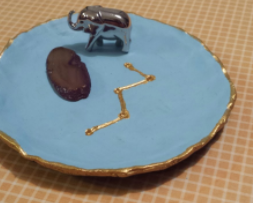
Inspired by We're Going to Make It's Astrological Sign Trinket Dish, I created one of my own with the constellation Cassiopeia, my favorite constellation. I really love the way it turned out. The instant I saw this project on their blog, I knew I had to make it.
Materials:
- clay (oven-bake)
- cup or bowl
- plastic knife
- pencil (or other object with a point)
- acrylic paints
- paint brushes
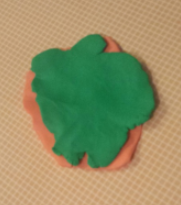
I started with just the green clay, then realized that I'd need more, so I added orange. I'd suggest using a lighter colored clay so you don't need to use as many coats of paint for full coverage.
I rolled out the clay and cut it into a circle by tracing around a mug. Once I had my clay into the shape I wanted for my dish (I crimped the edges with my fingers), I took a pencil to poke holes where the stars of the constellation would be and then dragged the pencil to draw faint lines connecting the stars.
I kept fiddling around with the shape, trying to perfect it, but I eventually said enough is enough and put it into the oven according to the directions. My dish probably could have baked a few minutes longer because it is still a little bendable.
After letting the dish cool, I started painting it. I used a light blue for the top and for the bottom, I mixed a few colors to get somewhere between a forest green and turquoise color.
For the last step, I went in with gold acrylic paint to fill in the constellation and also made a gold edge around the tray.
to see how I made the Galaxy Bracelet in the image above, click here
Thursday, November 23, 2017
Mae Jemison
When I took AP U.S. History in high school, we did a project called "Historical Character Day" after completing the lengthy coursework and dreaded AP exam. We could chose to be any significant person in American history and had to pretend to be that person, introducing ourselves to the entire class and then interacting with other important, well-known people of history. So, as you might have already guessed, I chose to be Mae Jemison.

The following is the information I collected as I prepared for Historical Character Day so that I would be able to fully know my person inside and out:
Name: Mae Jemison
Born: October 17, 1956
Contribution to History: the first black female astronaut
Significance to America:
- First African American woman admitted to the space program and in space
- Science Mission Specialist
- Advocate for women’s and civil rights
- Area Peace Corps medical officer for Sierra Leone & Liberia
- Awards:
- 1988 - Essence Science and Technology Award
- 1992 - Ebony Black Achievement Award
- 1993 - Montgomery Fellowship from Dartmouth College
- 1990 - Gamma Sigma Gamma Woman of the Year
- 1992 - public school in Detroit named after her
- 2004 - International Space Hall of Fame
- 1993 - National Women’s Hall of Fame
- Organizations:
- American Medical Association
- American Chemical Society
- American Association for the Advancement of Science
- World Sickle Cell Foundation
- American Express Geography Competition
- Center for Prevention of Childhood Malnutrition
- Established Jemison Group, a company for research, development, and marketing of advanced technologies
- Established The Earth We Share, a science camp to encourage (especially girls) to learn about science & global issues
- She can speak Russian, Japanese, and Swahili
- She started college at Stanford University at 16 years old and then went on to med school at Cornell
- She worked in Cambodian refugee camps
- Her space shuttle, Endeavour, was the only one named by children
- Was featuered in LEGO's "Women of NASA" set [read my post about it here]
- Made an appearance in Star Trek: The Next Generation
- Is an advocate for peace and equality
- Favorite Hobby: theater/dance
- Favorite Music: modern jazz, African dance, West Side Story
- Favorite Book: A Wrinkle in Time & The Arm of the Starfish [because they each feature female scientists heroines]
- Favorite Subject in School: science and technology, but also loved art just as much
- Other Interests:
- cooking
- watching movies
- weight lifting
- gardening
- traveling
- photography
- skiing
- volleyball
As part of the project, I had to describe the type of person I'd see myself (Mae Jemison) getting along with the best:
Someone who supports human rights and has a heart for all people no matter their race, gender, social standing, etc. Someone who is interested in science and technology, but also has an appreciation for the arts. Someone who loves learning and new experiences and is always up for an adventure and likes nature and serving others. Someone who will support me on all my endeavors (no pun intended).
We also had to bring in a food that the person liked/would have eaten in that time. I spent a long time looking for different 'space food' recipes and came across a video of Chris Hadfield making a sandwich out of a tortilla with peanut butter and honey. They use tortillas in space instead of bread because it doesn't make crumbs and it is more compact, thus avoiding bread crumbs from floating around in zero gravity. So I brought in these 'Space Shuttle Sandwiches' or what I liked to call PB&Jems.
On Historic Character Day, I wore a NASA tee shirt and I even spoke a little bit of Swahili ... or what I was able to learn from Google Translate ;)
Unaweza Daima Ngoma Kama Wewe Ni Daktari Lakini Huwezi Daktari Kama Wewe Ni Damfe -- “You can always dance if you’re a doctor, but you can’t doctor if you’re a dancer”
Some of the amazing people I (as Mae Jemison) had the opportunity to interact with included: Thomas Edison, Grace Hopper, Elizabeth Blackwell, Louis Armstrong, Sally Ride, Maya Angelou, Eleanor Roosevelt, JFK, and Amelia Earhart ... all of whom were fellow scientists, aviators/astronauts, feminists, and African Americans from various time periods.
Finally, here are a few other quotes from Mae Jemison that I came across in my research that I enjoyed:
“Some of the most fun people I know are scientists”
“I stayed in the astronaut program until 1993. People ask me why I left. I thought I had a lot of things to contribute that would be difficult to do if I stayed. I thought I could have a stronger voice as an advocate for space exploration. So I ended up starting my own technology consulting company”
“What we find is that if you have a goal that is very, very far out, and you approach it in little steps, you start to get there faster. Your mind opens you to the possibility."
♡
Sunday, November 12, 2017
Image of the Sun (pt. 2)
This was my second of three times looking at the image of the Sun as it appears on a folder through the quadrant. Here's a quick look at the differences between my two observations:
Part 1 Part 2
October 2 November 8
4:20 pm EDT 3:45 pm EST
23° altitude 9° altitude
The shape on both days was approximately the same, but again, not spherical like you would imagine the Sun's reflection being. The change in altitude would also need to take into account the fact that we changed from Daylight Savings to Standard Time, meaning that when I looked that the Sun's image for the second time, it was equivalent to 4:45 when I had done part 1, so the Sun would have been lower in the sky anyways; but there is also the factor that the Sun is getting lower in the sky as we move toward winter. So there are two factors that made the altitudes so different from one another.
read my Image of the Sun (pt. 1) post here: https://northstargazer.blogspot.com/2017/10/image-of-sun-pt-1.html
Friday, November 10, 2017
‘Women of NASA’ LEGO collection finally released
Here's
a look at what each women did, their legacies now able to be passed down to
encourage and inspire young girls: (info came from the building
instructions booklet that comes with the set)
Sally
Ride- was selected out of 8,000 applicants for NASA's astronaut
training and became the first American woman in space in 1983. She founded
Sally Ride Science and was awarded the Presidential Medal of Freedom.
Mae
Jemison- was selected out of 2,000 applicants for NASA's astronaut
training and became the first woman of color in space in 1992. Her work in the
Peace Corps, at NASA, and in the creation of technology companies (among many
other accomplishments) have led her to receive countless awards and honors
such as the Women's and the International Space Hall
of Fame.
(make
sure to watch out for an upcoming feature on Mae Jemison)
Margaret
Hamilton- an MIT computer scientist and NASA's head developer of
flight software for Apollo 11, the mission whose crew were the first to walk on
the Moon. She founded Hamilton Technologies and was awarded the Presidential
Medal of Freedom and NASA's Exceptional Space Act Award.
Nancy
Grace Roman- this activist for women in science started an astronomy club
in 1936 at age eleven, was educated in the field, and became NASA's first
female executive as the first ever Chief of Astronomy. As "Mother of
Hubble", she is honored in various ways through NASA and she was awarded
with the NASA Exceptional Scientific Achievement Medal.
A fifth woman, Katherine Johnson,
whose story is the focus of the film Hidden
Figures, was unfortunately not approved to be included. The two other major
parts of this set are the Hubble Space Telescope (developed by Nancy Grace Roman)
and the Space Shuttle Challenger (Sally Ride). Children who play with this LEGO
series will see that women have gained acceptance in STEM fields and will begin
to view these women as role models and examples for what they can and will accomplish.
follow the Women of NASA Lego on Twitter @LegoNASAWomen
Works Cited
Pattillo , Mia. “New Lego Set Celebrates Women in NASA.” The Brown Daily Herald, Brown Daily Herald, 31 Oct. 2017,
Walsh, Michael. “LEGO Will Honor Women of NASA in Newest Set.” Nerdist, Chris Hardwick,
28 Feb. 2017
28 Feb. 2017
Friday, November 3, 2017
Waxing Gibbous
I stepped outside on Halloween to see just what you'd expect on this holiday: a spooky Halloween Moon. Unfortunately, it wasn't a Full Moon, it was a Waxing Gibbous. But the way the clouds were situated around it, with bright light shining through only made me think of ghouls and goblins galore.
I did some quick measurements: it was 30° above the horizon at 170° S. I noticed that it seemed a bit smaller than normal, and I wondered why it had finally come back up from beneath the horizon as it had been in previous nights.
Thursday, November 2, 2017
This Day in Space History: November 2
1885
Astronomer Harlow Shapley was born. During his life, Shapley studied stars and galaxies, proving through measurements of star dimensions that the Sun wasn't, in fact, positioned at the center of the Milky Way Galaxy, but 30,000 light years away from its center. At the center of the galaxy were star clusters positioned spherically in Sagittarius. Shapley’s discoveries helped scientists formulate the first realistic estimate of the size of our galaxy which was 10x larger than previously thought. As a research professor at Harvard and the director of the College’s observatory, Shapley observed metagalaxies, proposing his “liquid water belt” or habitable zone theory.
1978
The crew of the USSR's Soyuz 29 mission returns back to Earth aboard Soyuz 31. The mission was launched June 16, 1978 and docked to Salyut 6. The craft returned to Earth September 3rd, but the crew stayed an additional two months. Soyuz 31 was launched August 26th and docked the next day, eventually bringing home Kovalyonok and Ivanchenkov of the former mission in November.
2000
https://www.scientificamerican.com/article/international-space-station-is-15-years-old-first-commander-remembers/The first ISS crew, launched on October 31st, arrived at 5:23 am EST. The crew of Expedition 1, which would last four and a half months, consisted of Commander Bill Shepard and Russian cosmonauts, Yuri Gidzenko and Sergei Krikalev. The current ISS Expedition is 53
For a complete list of today’s Space History, see http://www.astronautix.com/n/november02.html
Wednesday, November 1, 2017
Happy Halloween
Search up "astronaut costume" on Pinterest and you'll find adorable kids smiling and posing as Neil Armstrong, and DIY projects that require high dedication to complete by October 31st. But this year, the three NASA astronauts (not the ones who rang your doorbell last night) and the other three members of the ISS crew dressed up for the spooky occasion.
They showed the world on Twitter how they celebrate in zero gravity with this photo and video: https://twitter.com/Space_Station/status/925438767162384384
My personal favorite is the Minion shirt donned by Space Station Commander, Randy Bresnik. Which costume do you like best? Let me know in the comments!
⛤⋆⛤⋆⛤
On October 26, NASA released their "Spooky Space 'Sounds'" playlist of noises such as the sci-fi Whistler Waves and Saturn's unworldly Radio Emissions, even the faint church bells of Liquid Helium. These tracks sound just like those in sci-fi films -- I wonder if the producers had access to some of these sounds in the creation of such films or if they just guessed right?! Next Halloween I won't be playing those CDs of your typical spooky Halloween sound effects, I'll be playing NASA's space sounds -- just as spooky, maybe even more so, because they tell a real story: that of the universe.
Listen to the sounds and read more from NASA here: https://www.nasa.gov/vision/universe/features/halloween_sounds.html
Subscribe to:
Posts (Atom)