Sunday, January 21, 2018

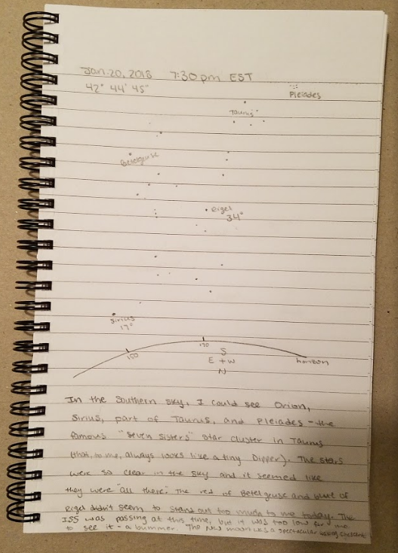
January 20, 2018

On this night, the stars were so clear in the sky that it seemed like they were "all there". The Moon, to the northwest, was a spectacular waxing crescent. The whole time I spent with my eyes up to the sky, I was whispering "oh wow" on repeat to myself, taking in the sight. Below, you'll find my observations for the northern and southern skies, and a small comment about the eastern sky. I was out so long that I didn't even get the chance to look at the western sky! But of course, I did look west for a second, just to see Cassiopeia!


In the southern sky, I could see Orion, Sirius (the brightest star in the sky), part of Taurus, and Pleiades (the famous "Seven Sisters" star cluster in Taurus ~ that, to me, looks like a tiny Dipper!). The red of Betelgeuse and the blue of Rigel didn't seem to stand out to me as much today. The ISS was passing by at this time, but it was unfortunately too low behind the trees for me to see.


In the northern sky, I saw both Dippers, but only parts of Ursa Minor (it's always fainter than Ursa Major). You'd expect that for the two constellations everyone knows since childhood not to be so awestruck, but today, I was even saying "oh wow" to the Big and Little Dipper.


I saw a lot in the eastern sky as well, but I'd already been out in the cold for 20 minutes, so I didn't draw them, but, with the help of my trusty SkyView app, I was able to see Capella & Menkalinan, Castor & Pollux, and Alhena & Procyon, among many others (I did write down 2 other stars' names, but once inside, I couldn't even decipher what I'd written!). 

Last night's observations, along with my recent research about the Very Large Telescope (read my new post here) spoke to and inspired me, causing that flame of passion to burn a little stronger within me.

The Very Large Telescope

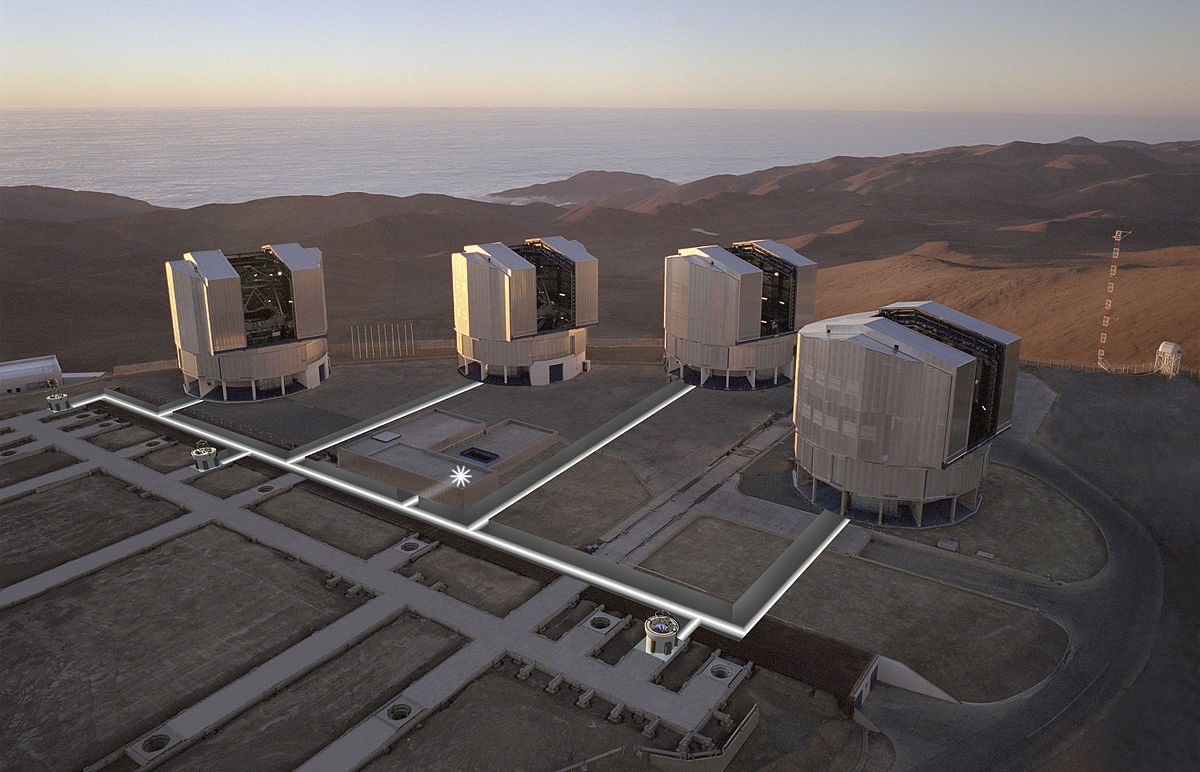
Image result for very large telescopeThe Very Large Telescope, owned and managed by the European Southern Observatory (ESO) is located in Cerro Paranal, Chile. The facility consists of four individual rotating telescopes, Antu (Sun), Kueyen (Moon), Melipal (Southern Cross), and Yepun (Venus), named from the indigenous Mapuche language. The elevation of the site is 2,635 meters. Construction of the VLT began in 1991 and it made its first observation in 1998.

Image result for very large telescope
The Very Large Telescope is an optical telescope that is able to detect ultraviolet, visible, and infrared light waves. It uses Ritchey-Cretien reflectors and interferometry, a technology that creates higher resolution images by combining light wave signals underground. The telescope is used to view deep space objects as faint as magnitude 30, which means they are four billion times fainter than what is visible to the naked eye. Each of the four unit telescopes has an aperture of 8.2 meters. The facility also has four smaller auxiliary telescopes, each of which is 1.8 meters in diameter. When combined through interferometry, the telescopes can have an aperture of up to 200 meters in diameter. Each unit telescope has an angular resolution of 50 milliarcseconds (an arcsecond measures the angle between two objects to the observer). When combined by interferometry, this resolution is reduced to only 2 milliarcseconds, which the ESO defines as being able to distinguish two points on the ISS separated by the width of a single sesame seed from Earth or being able to read a newspaper on the Moon!
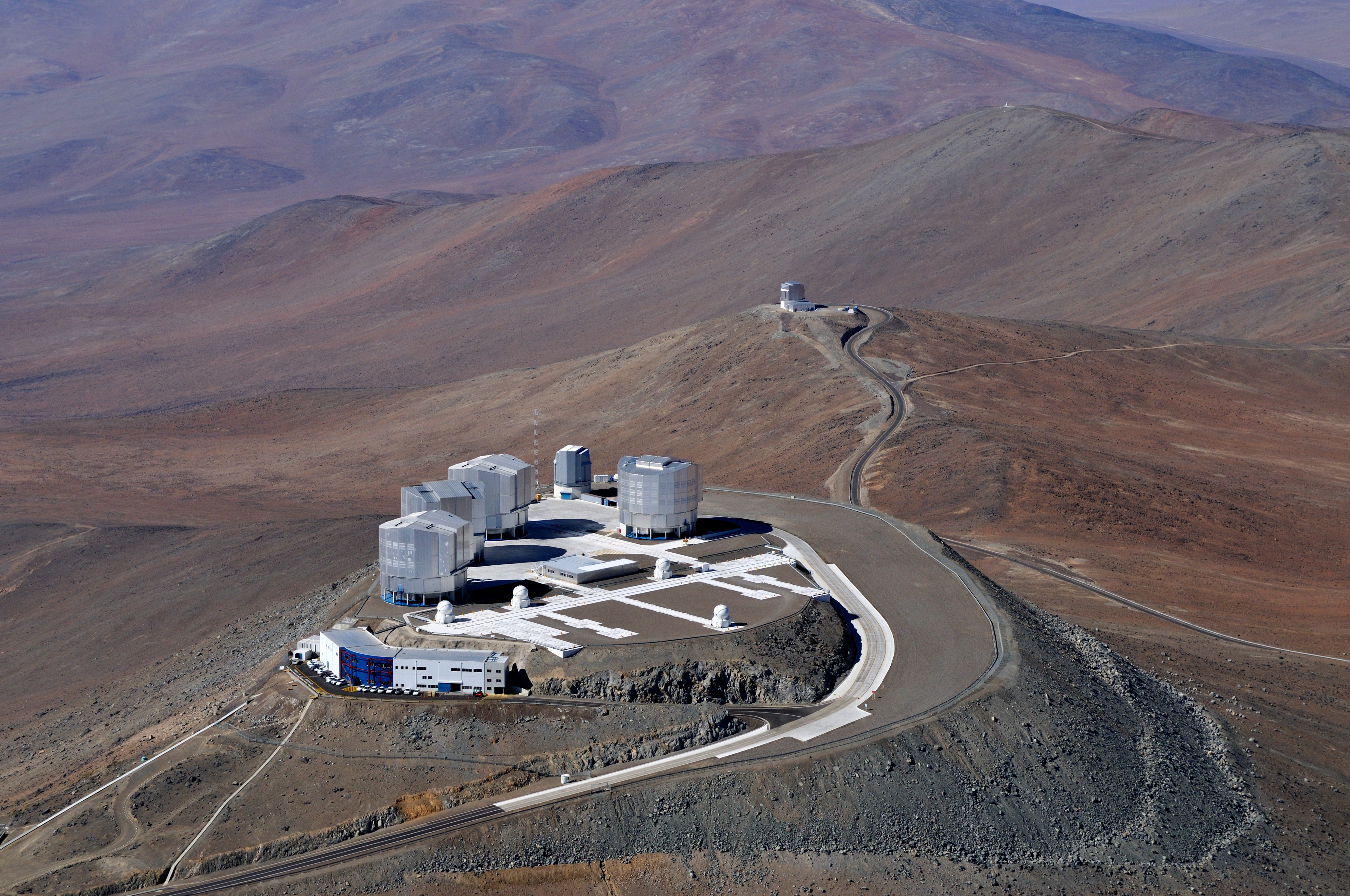
Image result for very large telescope
The VLT had made many discoveries including:
* discovered the most massive star, R136a1, which is 265x more massive than our Sun
* observed the afterglow of the furthest known gamma ray burst
* watches stars circle around the black hole at the center of our galaxy
* produced the first image of an exoplanet and measured the planet's mass
* discovered the Great Cold Spot on Jupiter


On the homepage of the website, you can view a live panoramic image of the Paranal Observatory which I have linked here with a map of the site, which includes its high-end "resort" called the Residencia where astronomers and engineers live.
http://www.eso.org/public/usa/teles-instr/paranal-observatory/vlt/ 

The last thing I have for you today is an amazing set of images taken by the VLT. The link below is from the ESO and contains 682 unbelievable, groundbreaking images. I scrolled through all 14 pages on the website clicking on the ones that I wanted to learn more about (which was a LOT). And not very far into the collection, my eyes were tearing up. Sure, I'm an emotional person, but looking at these sparked something in me. Inspiration? Hope? Just pure awe? I don't know what it was, but these pictures of deep space that are possible through the abilities of our own humankind truly struck me. 
I'll insert here some of my favorites:
http://www.eso.org/public/images/archive/search/list/1/?adv=&facility=31 
                                                 Jupiter                           Spiral Galaxy NGC 1232     


Red flames of Betelgeuse          Jewel Box cluster    


       Eta Carinae Nebula               Gas cloud being ripped 
                                                     apart by the black hole at the 
                                                 center of the Milky Way

Outbursts from a newborn star in the constellation Orion

Rosetta's Comet

Dust ring around the star           Globular cluster 47 Tuc
 HR 4796A in Centaurus                                                   

  
The protoplanet that orbits the             Colliding galaxies          
young star HD 100546 is seen                                                    
in the star's dust and gas                                                     
                                                   
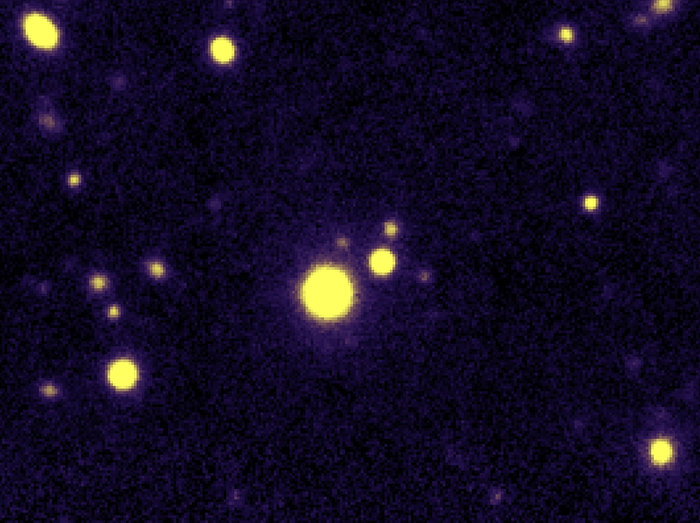
VLT snaps an exotic exoplanet “first”Triple quasar QQQ 1429-008
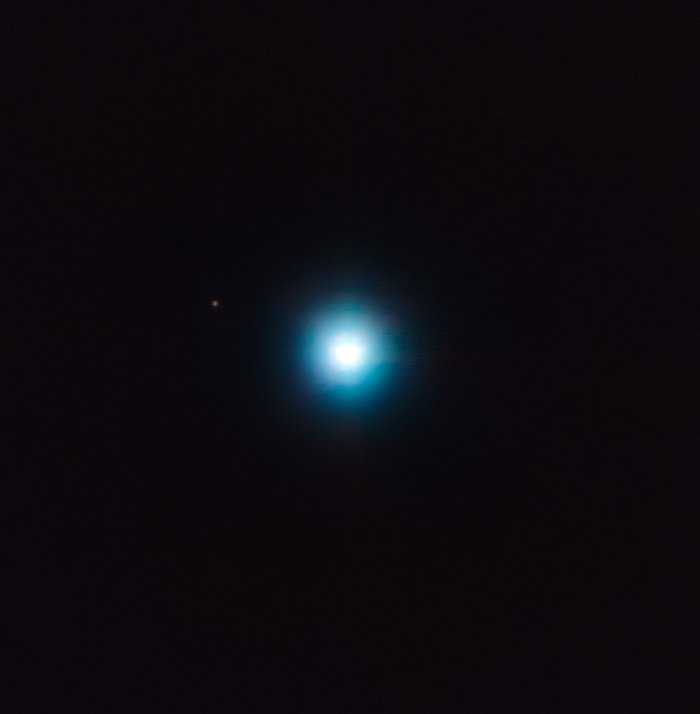
     Exoplanet CVSO 30c           Triple quasar QQQ 1429-008


Never forget to look up and beyond,
                                       🌠
    North Star Gazer 🔭


Works Cited

alienarka. "VLT Trailer 2009 (Paranal, Chile)." Online video clip. YouTube. 4 December 2009.
“Angular Measurements.” Cool Cosmos, IPAC-Caltech, coolcosmos.ipac.caltech.edu/cosmic_
        classroom/cosmic_reference/angular.html.
Ferris, Timothy. Seeing in the Dark: How Backyard Stargazers Are Probing Deep Space and Guarding
Earth from Interplanetary Peril. Simon & Schuster, 2002.
Greenhaven Press. Exploring Science and Medical Discoveries: Astronomy. Thomson Gale, 2006.
Gregersen, Erik. “Very Large Telescope.” Encyclopædia Britannica, Encyclopædia Britannica, Inc., 7
        Mar. 2016, www.britannica.com/topic/Very-Large-Telescope.
Nave, Rod. “Very Large Telescope (VLT).” HyperPhysics, hyperphysics.phy-astr.gsu.edu/hbase
        /Solar/VLT.html.
“Very Large Telescope.” ESO United States, www.eso.org/public/usa/teles-instr/paranal-
        observatory/vlt/.

Wednesday, January 17, 2018

January 10, 2018

I'm sorry that I haven't been posting much lately, but I'm back! I had a burst of inspiration so get excited for the fun posts I have planned! (Seriously, earlier today I was tearing up looking at something that you'll hopefully get to see very soon)


⭐   ☆   ⭐   ☆   ⭐


Facing 165° south, it was interesting to note the shifts in the positions of the Moon, Mars, Jupiter, and Spica since my previous observations, which were all generally at the same time. On November 28th, Jupiter was much closer to the horizon, Mars and Spica were almost next to one another, and there was no Moon (see picture below). This change is due to the differences in the orbits of the planets around the Sun. In this observation, Mars did not appear as red as it does other days. The Moon was in the waxing crescent phase. Also, the coloring of this picture does not do the sky justice- the sunrise was a much more vivid orange.

Monday, January 1, 2018

January 1, 2018

Happy New Year, everyone!! 

My Observation Notebook project is finished now (although I still have more observations to post here) but I am happy to announce that I'll be continuing my observations. My dad surprised me this Christmas with this notebook that he ordered with my blog logo and a star chart printed on the front. In here, I'll be doing my own personal observation notebook. Since this one is separate from class, the format will be a little different because there are no guidelines. And as for the blog posts, I'm not sure exactly how I'll set them up but for this one, I'm typing out the paragraph I wrote in the notebook, adding a little bit more. 
Thanks so much for reading! Here's to a great 2018- I'm looking forward to continuing to explore the night sky together!


Just as I was going to bed at almost 2 am, I could see how bright it was outside, so I got up and looked out my window. The moon was full and bright at due west, and I could see part of Orion. Through the window, without my glasses on, I could see the red of Betelgeuse - if that tells you anything about how dark and clear the sky was! I'm not positive, but this might've been my first time seeing Sirius, which is the brightest star in the night sky. It most certainly was the brightest star, so much that I had to check the SkyView app to see what star it was because at first sight I thought it must have been a satellite or something! Wow, that was an amazing sight in itself! The moon's light created a beautiful shadows of the trees in the snow on the ground- another sight in which I took delight. I remember thinking that it was cool that January 1st was a Full Moon, but when I looked it up, according to moongiant.com, on December 31st, the moon was 96% illuminated and 99% on January 1st - "not quite a full moon." But even if it doesn't fall right on the start of a new year, that only means that I have tonight to look forward to as even more spectacular.

                   Shine bright and keep dreaming,
                               ✰North Star Gazer

Sunday, December 31, 2017

Altitude of the Sun (pt. 2)


Quoted from my Part One post, “When measuring the altitude of the Sun, it is important not to look directly at the sun” yet in this observation, that’s what I did. However the Sun was so low in the sky (5°)  and I only saw a few rays through the trees (through the small hole of the quadrant) that even though my eyes were exposed to UV Rays, I did not consider it “looking into the Sun.”


At 3:50 pm EST on December 14, 2017, the Sun was 5° above the horizon

Friday, December 29, 2017

Polaris, Cassiopeia, and the Big Dipper Later in the Night


Two and a half hours later, Cassiopeia had slightly shifted position [*vertical, not horizontal] and I didn’t think the Big Dipper changed very much. So there wasn’t much to report for changes. Once again, the southeastern sky was an astounding sight and I’m so glad that this night gave me many observation opportunities. ✪ The sky was absolutely perfect. ♥


Related Observations:
Polaris, Cassiopeia, and the Big Dipper  http://northstargazer.blogspot.com/2017/10/polaris-cassiopeia-and-big-dipper.html?m=1
Polaris, Cassiopeia, and the Big Dipper Later in the Year  http://northstargazer.blogspot.com/2017/12/polaris-cassiopeia-and-big-dipper-later.html?m=1

Polaris, Cassiopeia, and the Big Dipper Later in the Year


When I went out this night, there was so much to see and being out there left me with such a happy feeling.
For this task I had to view Polaris, Cassiopeia, and the Big Dipper and compare what I saw to when I observed them earlier in the year (10/1). I noticed a shift in the orientation of the Big Dipper and that Cassiopeia had moved to the opposite side of Polaris.
It wasn’t necessary that I included these in my drawing, but I saw Castor and Pollux, Capella, and Orion, the latter two of which were very bright.

The next task was to go out a few hours later and look at the same things again, so let’s check out what I saw later in the night!


Related Observations:
Polaris, Cassiopeia, and the Big Dipper  http://northstargazer.blogspot.com/2017/10/polaris-cassiopeia-and-big-dipper.html?m=1
Polaris, Cassiopeia, and the Big Dipper Later in the Night  http://northstargazer.blogspot.com/2017/12/polaris-cassiopeia-and-big-dipper-later_29.html?m=1


Monday, December 25, 2017

Christmas Night Sky

After our holiday festivities, as I walked to the car, I looked up into the dark and enchanting sky. I'd have to say that the constellation Orion was the clearest I've ever seen it, so much that you could see the range of star colors (indicating the range of temperatures), with the red Betelgeuse and blue Rigel. I also pointed out Cassiopeia to my family, but it wasn’t very bright and it was hard to see the end star, Segin. There were a lot of bright stars in the western sky and I could easily see the Summer Triangle but it was too cold to stay out long, so I didn’t get the chance to point out much more than that. Being out on Christmas night looking at a beautiful night sky made me happy -as it always does- and was a great way to end the day’s celebration.
I hope you all had an amazing holiday with your loved ones. 🎄
         ♡ North Star Gazer

Tuesday, December 19, 2017

Super Full Moon


I was expecting a little more from this Super Full Moon, but it honestly didn't seem too much larger than normal. The coloration of the sky was very cool: a glowing blue-green sky closest to the moon and getting darker and deeper blue going outward. According to timeanddate.com, a Supermoon is "a Full or New Moon that occurs when the center of the Moon is less than 360,000 kilometers (ca. 223,694 miles) from the center of Earth." and a Super New Moon is 12-14% larger than normal, which explains why my expectation of "super" was not completely met.

Yesterday (12/18) was actually the Micro New Moon. It was cloudy, but I could see a little bit of a pink color in the sky.

Monday, December 18, 2017

International Space Station ☄


I had a schedule of when the ISS would be in the sky each night, and for two weeks, I'd been watching for it, but it was always cloudy. The first day I looked, it was a clear night and I was looking in the right spot, but for some reason, I just didn't see it. Now, I can't believe that I didn't see it that night because when I finally saw it for this observation, it was so big compared to the stars, shining brightly and moving fairly quickly in an arc across the sky. I remember stepping outside and looking up, spotting the ISS immediately. A smile stretched across my face - I was happy, excited, and thinking about the astronauts and scientists up there. Once the space station started to leave my view, I remember taking off one shoe and hopping one-footed through my house to the front door so I wouldn't let the snow inside. I watched the ISS pass through Cassiopeia (my favorite constellation), travel east, and then set behind the trees. It was suddenly over, but those two minutes of awe and excitement were one hundred percent worth it. 

Tuesday, December 12, 2017

Third Quarter Moon


This third quarter moon shone brightly through the light blue southern sky. I wondered whether it was still considered third quarter or if by this point it had become a waning crescent because this phase was technically on the 10th, but this was in the morning on the 11th, so I’m curious as to when it officially “changes” phase.

Thursday, December 7, 2017

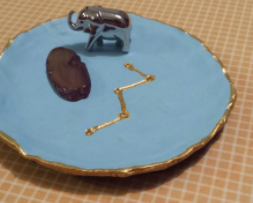
Constellation Trinket Tray

Inspired by We're Going to Make It's Astrological Sign Trinket Dish, I created one of my own with the constellation Cassiopeia, my favorite constellation. I really love the way it turned out. The instant I saw this project on their blog, I knew I had to make it.
Materials:
  • clay (oven-bake)
  • cup or bowl
  • plastic knife
  • pencil (or other object with a point)
  • acrylic paints
  • paint brushes

I started with just the green clay, then realized that I'd need more, so I added orange. I'd suggest using a lighter colored clay so you don't need to use as many coats of paint for full coverage.
I rolled out the clay and cut it into a circle by tracing around a mug. Once I had my clay into  the shape I wanted for my dish (I crimped the edges with my fingers), I took a pencil to poke holes where the stars of the constellation would be and then dragged the pencil to draw faint lines connecting the stars.
I kept fiddling around with the shape, trying to perfect it, but I eventually said enough is enough and put it into the oven according to the directions. My dish probably could have baked a few minutes longer because it is still a little bendable.
After letting the dish cool, I started painting it. I used a light blue for the top and for the bottom, I mixed a few colors to get somewhere between a forest green and turquoise color.
For the last step, I went in with gold acrylic paint to fill in the constellation and also made a gold edge around the tray.


I'm really happy with the way my trinket tray turned out! It would be a great holiday gift for someone who loves the stars; you could do either one of the Dippers or their astrological sign, as was done by We're Going to Make It ~ thank you for the inspiration.
to see how I made the Galaxy Bracelet in the image above, click here